


DOWN SYNDROME RISK FACTORS
Risk Factors for a Down Syndrome Pregnancy
| Yes, this page is loaded with the Down Syndrome risk factors that may be used to estimate the chances of having a baby with Down Syndrome.
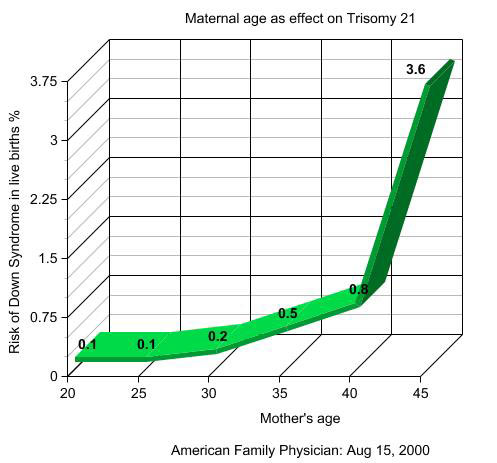
When you do this though, it is important to realise that the risks and factors are all a probability game. For example the Down Syndrome risk factor reaches 3.6% of live births when mother’s age is around 44 years. That means that 96.4% of live births don’t have Down Syndrome! |
 |
|---|
Truth is, that irrespective of what risk factor for Down Syndrome you work out, the bottom line is that you either will or wont give birth to a child with Down Syndrome. The only way to know for sure whether the baby has Down Syndrome while in utero, is to do the concrete tests for Down Syndrome.
CONTENTS: 1… Down syndrome pregnancy risk factor by AGE OF MOTHER (Maternal age) — 2… Down syndrome pregnancy risk factor by AGE OF FATHER (Paternal Age) — 3… Number of babies — 4… Environmental influences that can cause Down Syndrome — 5… Fertility problems and birth defects increase with both maternal age and paternal age — 6… Down Syndrome adults becoming biological parents – having their own kids — 7… Contact us if you need to.
To help yourself, you might like to try these all natural treatments for Stretch Marks OR Acne ORHeadache / Migraine Click here to find the best natural treaments for most common conditions.
1… Down Syndrome Risk Factors by Age of Mother (Maternal Age):
Mother’s age 15 years, Down Syndrome risk factor is 1 pregnancy in 1663
Maternal age 16 years, Down Syndrome risk factor is 1 pregnancy in 1659
Mother’s age 17 years, Down Syndrome risk factor is 1 pregnancy in 1654
Maternal age 18 years, Down Syndrome risk factor is 1 pregnancy in 1647
Mother’s age 19 years, Down Syndrome risk factor is 1 pregnancy in 1638
Maternal age 20 years, Down Syndrome risk factor is 1 pregnancy in 1627
Mother’s age 21 years, Down Syndrome risk factor is 1 pregnancy in 1611
Maternal age 22 years, Down Syndrome risk factor is 1 pregnancy in 1591
Mother’s age 23 years, Down Syndrome risk factor is 1 pregnancy in 1564
Maternal age 24 years, Down Syndrome risk factor is 1 pregnancy in 1531
Mother’s age 25 years, Down Syndrome risk factor is 1 pregnancy in 1487
Maternal age 26 years, Down Syndrome risk factor is 1 pregnancy in 1433
Mother’s age 27 years, Down Syndrome risk factor is 1 pregnancy in 1367
Maternal age 28 years, Down Syndrome risk factor is 1 pregnancy in 1288
Mother’s age 29 years, Down Syndrome risk factor is 1 pregnancy in 1195
Maternal age 30 years, Down Syndrome risk factor is 1 pregnancy in 1089
Mother’s age 31 years, Down Syndrome risk factor is 1 pregnancy in 975
Maternal age 32 years, Down Syndrome risk factor is 1 pregnancy in 855
Mother’s age 33 years, Down Syndrome risk factor is 1 pregnancy in 733
Maternal age 34 years, Down Syndrome risk factor is 1 pregnancy in 617
Mother’s age 35 years, Down Syndrome risk factor is 1 pregnancy in 509
Maternal age of 36 years, Down Syndrome risk factor is 1 pregnancy in 412
Mother’s age of 37 years, Down Syndrome risk factor is 1 pregnancy in 329
Maternal age of 38 years, Down Syndrome risk factor is 1 pregnancy in 259
Mother’s age of 39 years, Down Syndrome risk factor is 1 pregnancy in 202
Maternal age of 40 years, Down Syndrome risk factor is 1 pregnancy in 156
Mother’s age 41 years, Down Syndrome risk factor is 1 pregnancy in 119
Maternal age 42 years, Down Syndrome risk factor is 1 pregnancy in 91
Mother’s age 43 years, Down Syndrome risk factor is 1 pregnancy in 69
Maternal age 44 years, Down Syndrome risk factor is 1 pregnancy in 52
Mother’s age 45 years, Down Syndrome risk factor is 1 pregnancy in 40
Maternal age 46 years, Down Syndrome risk factor is 1 pregnancy in 20
of it being a Down Syndrome pregnancy. According to Hook, E.G., Lindsjo, A.
Mother’s age 48 years, Down Syndrome risk factor is 1 pregnancy in 16
of it being a Down Syndrome pregnancy. According to Hook, E.G., Lindsjo, A.
Maternal age 49 years, Down Syndrome risk factor is 1 pregnancy in 12
of it being a Down Syndrome pregnancy. According to Hook, E.G., Lindsjo, A.
Total risk of chromosomal damage in baby from all sources including Down Syndrome risk, is approximately double the probability of Down Syndrome – For example, 1 in 40 becomes 1 in 20. [If you already have a kid with Down Syndrome or other chromosomal damage, the risk of the next having chromosomal damage is often increased substantially, depending on the nature of the damage.]
The above information was provided to us by an obstetrician. The statistics mostly came from “Update 12, Prenatal Scrreening for Down Syndrome, Age Specific Performance…”.
2… Father’s Age (Paternal Age), and Down Syndrome Risk Factor of kid Being Born with Down Syndrome:

Harry Fisch and others, over the period 1983 to 1997, investigated 3,429 cases of Down Syndrome in relation to father’s age.
The researchers found that fathers over 40 years of age, when having kids to women aged over 35 years, had twice the Down syndrome risk factor, when compared with men 24 years of age and younger also having kids to women aged over 35 years. If the women were under 35 years of age, the father’s age had no effect on whether it would be a Down Syndrome pregnancy.
For mothers over 40 years of age, the researchers discovered that an increase of 50% in Down syndrome risk factor was caused by the advanced age of the father.
So, the biggest cause of Down Syndrome pregnancy is the advanced age of either or both the mother and father.
3… Number of babies a woman has can increase the risk of Down Syndrome, other trisomy disorders and other chromosomal disorders
Yes, if this is the fifth or more baby, the risk of Down Syndrome (Trisomy 21) is slightly increased. Also, Edward syndrome (Trisomy 18) and Patau syndrome (Trisomy 13) risk are also apparently increased slightly.
4… Environmental influences that can increase the risk of Down Syndrome:
Females, under the age of 35 years, who smoke have an increased risk of Down Syndrome in their babies. Cigarettes + oral contraceptives made it even worse. Genetics in Medicine 1999;1:80-88

5… Special Note On Fertility for both men and women:
The older a women becomes, the less fertile she is likely to become.
By the time she reaches 40, assuming she has been able to give birth before, the probability of getting pregnant and having a pregnancy run to full term is quite low, around one in a hundred, according to one specialist.
Contrary to popular belief, fertility clinics are normally unable to help older women.
For men, R. Glaser, et al, 2002, found in their research on Apert syndrome, that men, between the ages of 33 and 35 begin to experience a dramatic increase in fertility problems; this is also the age when women begin to experience fertility problems more markedly.
While Apert syndrome occurs only once in 160,000 births, the researchers think their findings may apply to 20 or so other genetic conditions [does not appear to include Down Syndrome at this time] that appear to be related to fathers above age 33 years.
In a nut shell, fertility problems increase markedly for both men and women, once they hit their mid 30’s.
Also, age and Down Syndrome pregnancy risk is the simplistic way of looking at the cause of Down Syndrome. Based on our current understanding, the real cause of Down Syndrome is starting to be understood. If you are interested, then visit our web page on the Cause of Down Syndrome.
MINI FAQ on fertility and age:
Hello
After my diagnosis at the first IVF doctor that I only had a 1 in 20 chance of falling pregnant, I saw many sites that had the same information – kind of saying there was no hope for me, unless I used a donor egg, but after three IVF attempts I’m now 4 months pregnant.
There are high FSH specialists that have a better success rate than other clinics so let people know that often times clinics will say no but you should keep looking.
Hi,
Although you are over the moon being four months along and all, the first said you had a 1 in 20 chance for success, not a zero chance.
IVF programs are now under a lot of pressure to be honest with couples. Many are finding they can’t conceive even with IVF, because they left it just a bit too late for their body. The real problem is people see famous stars and so on get pregnant with IVF and think they can do it just as easily, the thought that only 1 in 20 movie stars may be successful doesn’t even occur to them. The thought that they have to go back repeatedly doesn’t occur to them.
Normal female infertility normally becomes a problem between 36 and 65 years, and this is the message we have to get out to people – it’s better to have children earlier than 36, else you may not have them at all and regret it the rest of your life. The promotion, more income, normally doesn’t hold a candle to losing out on having children, and besides, IVF is well out of reach for most people financially.
All the best
Donald.
6… Adults with Down Syndrome, Can they be Biological Parents?
The answer is yes, but we are not sure how fertile they are.
Fatherhood is very rarely expected.
Motherhood is much more common.
Of mother’s with Down Syndrome, about 50% of their offspring will have Down Syndrome or another genetic condition causing developmental disability aka mental retardation. Fifty percent of their kids will be normal.
In stating these statistics for women, it should be borne in mind that the research which gives rise to them is very questionable, but it is the best we have at the moment that I am aware of.
7… Email us if you need to with any question about a Down Syndrome pregnancy risk.
I think I have covered everything on Down Syndrome pregnancy risk factors, but if you have any questions, please contact me.
Leave a Reply
You must be logged in to post a comment.